FHA and VA Home Loans with Credit Scores from 580
A credit score in the high 500s is not an automatic “no” at every lender. If another shop turned you down—or an automated system came back with a “Refer”—you still deserve a clear, honest look at your file.
First Lending Solutions reviews fixed-rate FHA and VA applications with credit scores from a 580 minimum, including files that need manual underwriting. We do not manually underwrite conventional (Fannie Mae / Freddie Mac) loans. A score alone never equals approval: income, debts, payment history, residual income (for VA), the property, and program guidelines all matter. This page explains what that process looks like and how to get ready for a conversation with a licensed loan officer.
What a 580 minimum means at First Lending Solutions
Here is our product policy in plain English:
- Minimum decision credit score: 580 for manually underwritten FHA and VA loans.
- Fixed-rate only. We do not advertise adjustable-rate mortgages (ARMs), non-QM products, or ITIN programs on this page.
- Conventional loans are not manually underwritten at First Lending Solutions. If your file needs a conventional path that depends on automated Approve/Accept findings, we will say so honestly and talk about what may still be possible.
- 580 is a floor for review, not a promise. Meeting the minimum does not guarantee approval, a particular loan amount, or a closing date.
If you are rebuilding credit after late payments, collections, or a past credit event, you are welcome here. We will talk about the full story—not just the three-digit number.
FHA at 580 vs VA at 580
Both programs can work for borrowers near a 580 score, but they are not the same product. A licensed loan officer can help you compare which path fits your eligibility, occupancy plans, and cash-to-close picture—without quoting rates or payments on this page.
FHA
FHA-insured loans follow HUD underwriting rules, including how decision credit scores and automated findings interact with manual review. Lenders may still add their own overlays on top of HUD’s baseline. When an automated underwriting system returns a Refer—or when a file must be reviewed under published FHA manual guidelines—a Direct Endorsement underwriter looks at the full package: documented income, debts, assets, housing payment history, and compensating strengths.
Important: This page does not list FHA or conventional down-payment percentages. Cash needed to close depends on the property, your assets, seller credits (when allowed), and your specific program path. If you have questions about down payment or cash to close, ask a licensed loan officer for a short, no-pressure conversation tailored to your file. For California FHA context, see our FHA loans in California page.
HUD’s Handbook 4000.1 is the primary public source for FHA underwriting concepts. Guidelines and credit-score methodology can change (including updates described in HUD Mortgagee Letter 2026-11 for case numbers assigned on or after January 1, 2027). Always verify current rules with your lender before you rely on any summary.
FHA loan amounts are capped by HUD county maximums—separate from FHFA conforming (conventional) limits and from VA entitlement math. For 2026, the HUD one-unit FHA forward limit for Riverside County and San Bernardino County is $690,000 (higher for 2–4 units). Confirm current figures on HUD’s FHA mortgage limits lookup or our California loan limits hub before you write an offer. A county maximum is a program ceiling, not an approval.
VA
The Department of Veterans Affairs does not set a minimum credit score for VA-backed home loans. Each lender sets its own overlays. Some lenders will not review a 580 file; others will—often through manual underwriting that weighs residual income, housing payment history, and the rest of your credit story.
First Lending Solutions works with fixed-rate VA loans from a 580 minimum, including manual underwriting. Eligible Veterans with full entitlement may buy with $0 down as a VA program feature; funding fee and closing costs may still apply, so $0 down is not the same as $0 cash to close, and partial entitlement can change the down-payment math. For eligible VA borrowers, we can consider loan amounts up to $2.5 million—an FLS capability ceiling, not a VA county cap—subject to entitlement, credit approval, VA guidelines, the appraisal, and overlays. A Certificate of Eligibility (COE) and a full underwrite are still required. Approval is never guaranteed by score alone.
For local entitlement, county limits, and Inland Empire buying tips, see VA home loans for Riverside and the Inland Empire (same launch package). The general program overview lives at VA home loans.
What manual underwriting is (and what a “Refer” means)
Most mortgage applications run through an automated underwriting system (AUS). Common outcomes include Approve/Accept-style findings or a Refer.
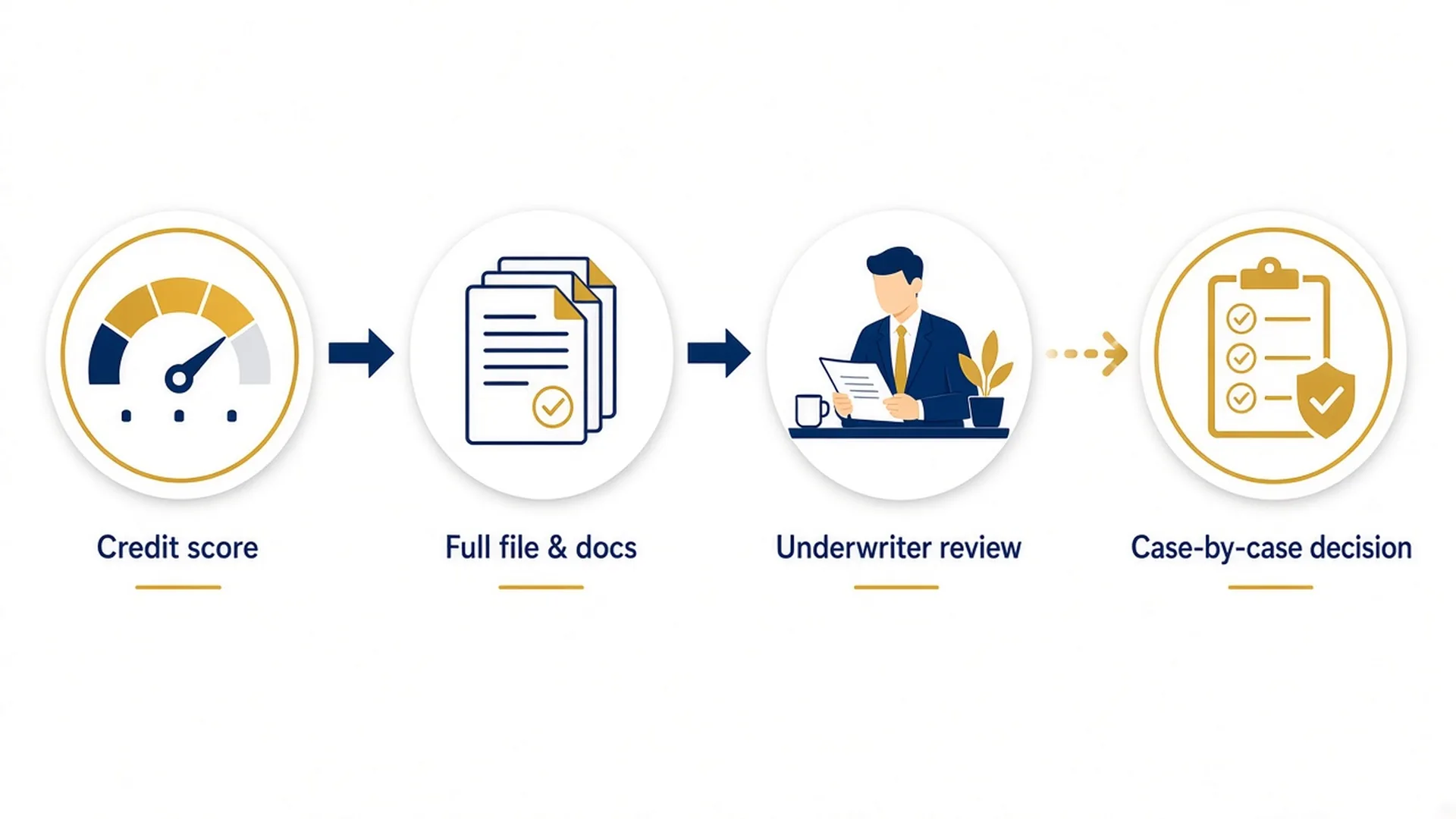
A Refer is not a denial. It usually means a human underwriter—a Direct Endorsement underwriter for FHA, or a VA underwriter for VA—must review the full file against published manual guidelines. Manual review can also follow after verification turns up information that requires a downgrade from an earlier automated finding.
Manual underwriting typically means:
- More documentation (letters of explanation, rent history, reserve statements, and so on)
- More time for a person to read the file carefully
- A case-by-case credit decision—not a closed door
It does not mean every file is approved, and it does not mean First Lending Solutions will stretch below our 580 minimum.
What an underwriter looks at
Besides the decision credit score on the mortgage credit report, underwriters commonly review:
- Payment history, especially housing (rent or mortgage) and other recurring obligations
- Income stability and how income is documented
- Debt-to-income relationships and, for VA, residual income (money left after major expenses)
- Reserves—verified assets that remain after closing
- Compensating factors—documented strengths that support the risk decision
- The property (appraisal, occupancy, and program property rules)
Public VA lender guidance has long emphasized that compensating factors are not a cure for clearly unsatisfactory credit. In other words, strong reserves or a high residual income figure do not erase a pattern of recent serious delinquencies. Exact wording and current chapter citations should be verified against the latest VA Lender’s Handbook (Pamphlet 26-7, Chapter 4) and HUD Handbook 4000.1 before publish—use current versions only.
Compensating factors in plain English
Compensating factors are strengths in the file that help an underwriter see why the loan can still be a reasonable risk. Examples at a concept level include:
- Verified cash reserves after closing
- Limited payment shock compared with current housing cost
- Strong residual income (especially on VA files)
- Stable employment with a clear track record
- Documented on-time rent or housing payments
No compensating factor guarantees approval. Underwriters weigh the whole file.
Steps to get your file ready
- Know which score the mortgage credit report shows. Consumer credit apps and free scores can differ from the decision scores lenders use. Ask your loan officer what the mortgage credit report shows.
- Gather income, asset, and housing-payment documents. Typical starters include recent pay stubs, W-2s or tax returns, bank statements, and proof of rent or housing payments.
- Write short, factual letters for past credit events. Explain what happened, when it was resolved, and what changed—without excuses or drama.
- Avoid new debt and unnecessary inquiries before applying. Opening cards, financing furniture, or co-signing can change the picture mid-process.
- Talk with a licensed loan officer about FHA vs VA for your situation. Eligibility, occupancy, entitlement (for VA), and cash to close all factor in. If you are comparing equity options later, our cash-out refinance vs. HELOC overview can help frame the conversation—without rate quotes.
After bankruptcy or foreclosure (high level)
FHA and VA programs generally include waiting periods (often called seasoning) after bankruptcy, foreclosure, or similar events before a new loan can be considered. Those periods depend on the type of event, how it was resolved, and whether the file is manually underwritten. HUD and VA publish the official rules; lenders apply them to each file.
Guidelines change—verify. Do not rely on a blog summary or an old quote from a friend. Ask a licensed loan officer to check current HUD Handbook 4000.1 concepts and current VA Lender’s Handbook guidance against your timeline. A waiting period that has been met still does not guarantee approval; credit re-establishment, income, and the rest of the file still matter.
Official starting points:
- HUD / FHA underwriting: HUD.gov and HUD Handbook 4000.1
- VA home loans: VA.gov Housing Assistance
FAQ
Can I be considered for an FHA loan with a 580 credit score?
Many borrowers with a 580 decision credit score can still be considered for an FHA loan, but the score is only one part of the file. FHA rules and each lender’s overlays both matter, and an automated finding of Refer can lead to manual underwriting rather than an automatic denial. First Lending Solutions reviews fixed-rate FHA applications with scores from 580, including manually underwritten files. Whether you qualify depends on income, debts, payment history, and the property—not the number alone.
Can I be considered for a VA loan with a 580 credit score?
The Department of Veterans Affairs does not set a minimum credit score for VA-backed loans; lenders set their own requirements. Some lenders will not review a 580 file; others will, often through manual underwriting that weighs residual income, housing payment history, and the rest of your credit story. First Lending Solutions works with fixed-rate VA loans from a 580 minimum, including manual underwriting. A Certificate of Eligibility and a full underwrite are still required, and approval is never guaranteed by score alone.
What is mortgage manual underwriting?
Manual underwriting means a human underwriter reviews your full mortgage file when an automated underwriting system cannot issue an Approve/Accept finding, or when the file must be reviewed under published FHA or VA manual guidelines. The underwriter looks at documented income, debts, assets, payment history, and compensating strengths such as reserves or stable employment. It usually means more documents, not a closed door—and it is still a case-by-case credit decision.
What do underwriters look at besides the score?
Payment history (especially housing), income stability, debts, reserves, residual income on VA files, compensating factors, and the property itself. A strong score does not replace weak documentation, and a lower score does not automatically end the conversation if the rest of the file is carefully prepared.
What are compensating factors?
Compensating factors are documented strengths—such as verified reserves, limited payment shock, strong residual income, stable employment, or on-time rent history—that help support a manual underwriting decision. They do not guarantee approval, and they generally cannot “cure” a clearly unsatisfactory recent credit pattern.
Does manual underwriting take longer?
Often yes, because a person is reading the full file and may ask for more documents. Extra time is not the same as a denial. Build a little flexibility into your purchase timeline and stay responsive to document requests.
Can I qualify after bankruptcy or foreclosure?
Possibly, after applicable HUD or VA waiting periods and with evidence that credit has been re-established. Waiting periods and documentation rules change—verify current guidelines with a licensed loan officer and official HUD/VA sources. Meeting a waiting period is not a promise of approval.
Do you manually underwrite conventional loans?
No. First Lending Solutions does not manually underwrite conventional (Fannie Mae / Freddie Mac) loans. Our manual underwriting path described on this page is for fixed-rate FHA and VA files with scores from a 580 minimum.
What should I prepare before I apply?
Know your mortgage credit report scores, gather income and asset documents, collect housing payment history, draft short factual letters for past credit events, avoid new debt, and schedule a conversation with a licensed loan officer about whether FHA or VA fits your situation.
Do FHA loans use the same loan limits as conventional loans?
No. FHA uses HUD’s own county maximum loan amounts, which are separate from FHFA conforming limits used for conventional loans. For 2026, the one-unit FHA forward limit in Riverside County and San Bernardino County is $690,000 (confirm on HUD or our California loan limits hub). That number is a program ceiling—not a promise you qualify for it.
Can eligible Veterans buy with $0 down on a VA loan?
VA loans may allow a $0 / zero down payment for eligible Veterans with full entitlement. Partial entitlement can change that math because remaining guaranty and county conforming limits may mean some cash is needed. The VA funding fee and closing costs may still apply, so $0 down is not the same as $0 cash to close. A COE and a full underwrite still decide whether a specific home works—$0 down describes the VA program benefit, not a guaranteed approval. Confirm current details on VA.gov loan limits and VA funding fee and closing costs.
Next step
If you were told your score was too low elsewhere, start with a calm conversation—not a hard sell.
- In California: Talk with a licensed loan officer about your credit – start here
- In other states where we can help: Start your application
You can also call our Riverside office at (951) 684-3307, visit Contact us, or learn more about working with a mortgage broker in Riverside or across the Inland Empire. For county loan-limit context, see California loan limits.
We are here to review the full file—payment history, income, residual income when VA applies, and the property—and to tell you honestly what is realistic.
1st Lending Solutions, Inc. DBA First Lending Solutions, NMLS 135932. CA DRE License #01482431. 3610 Central Ave, Suite 400, Riverside, CA 92506. Equal Housing Opportunity. Not a commitment to lend. Subject to credit approval and program guidelines. FHA loans are insured by the Federal Housing Administration and VA loans are guaranteed by the U.S. Department of Veterans Affairs; First Lending Solutions is not affiliated with or endorsed by HUD, FHA, VA, or any government agency.